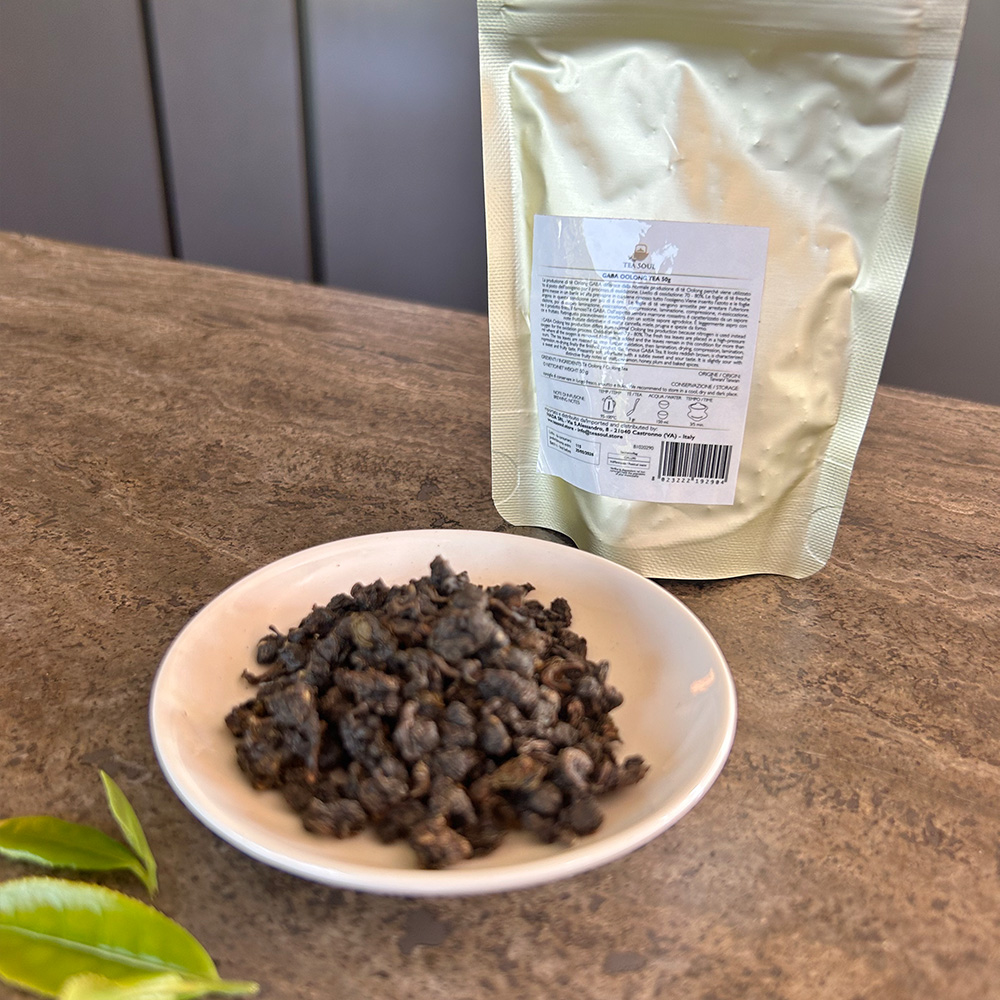
GABA oolong tea is a type of tea typical of Taiwan, obtained through a special processing of the leaves in an oxygen-free environment. In our range you will find two other products of this type, organic Gaba oolong and ruby Gaba oolong, where you will find more information about the benefits of the GABA molecule, which these leaves are rich in, and all the details about the tea production steps. The reasons why we are offering another version of this oolong are two. First of all, it was produced from this spring's harvest and therefore can express a flavor profile characterized by greater freshness and fragrance. Secondly, it has a slightly less intense roast than the others, with a considerable effect on the taste of the beverage. In particular, the flavor profile of this tea stands out for allowing its fragrance to emerge during tasting. Unlike the other two Gaba oolongs, in fact, this one reveals a sweet taste right from the start, making the roasting and the typical flavor of the GABA molecule take a back seat. The sweetness of this infusion strongly recalls a tropical fruit such as mango and is accompanied by a light fresh vegetal note. After this first impact, the beverage tends to give a greater warmth in the mouth, first revealing a taste similar to unprocessed cocoa and, following that, some woody hints. Compared to the other oolongs, this is definitely the one with the least intense spicy notes. Place of origin: Taiwan. Production: After harvesting, the leaves wither in the sun for a short time, followed by a resting phase on bamboo trays indoors. From there, oxidation begins through a manual massage of the leaf performed by the master producer, who will then let the leaves oxidize covered and with as little contact with air as possible, so as to increase GABA production in the leaves. Once the tea reaches the desired oxidation level, around 40%, the leaves are placed in a charcoal-heated oven where enzymatic activity is stopped. After this oven phase, the leaf is given its rolled shape thanks to a special machine or by hand, and once the tea has dried, it is ready to be consumed. Preparation: We strongly recommend infusing this tea using the traditional Chinese method (gong fu cha) to best enjoy these leaves. Following this preparation, you can use 5 grams of leaves, about 3 teaspoons, in a gaiwan of about 150 ml to obtain several infusions with different flavors. After a quick rinse of the leaves in water at 90°C, you can proceed with a first infusion of 40 seconds and then, keeping the water at the same temperature, you can continue using the same leaves by adding more water each time and increasing the infusion time by 10 seconds compared to the previous infusion. This tea has a longevity of about 7 infusions. For a classic Western-style preparation, we recommend 3 grams of leaves, about 2 teaspoons, in a 200 ml cup with water at 90°C for an infusion time of 3 minutes. Store in a cool, dry place away from direct sunlight.
Price VAT included
GABA oolong tea is a type of tea typical of Taiwan, obtained through a special processing of the leaves in an oxygen-free environment. In our range you will find two other products of this type, organic Gaba oolong and ruby Gaba oolong, where you will find more information about the benefits of the GABA molecule, which these leaves are rich in, and all the details about the tea production steps. The reasons why we are offering another version of this oolong are two. First of all, it was produced from this spring's harvest and therefore can express a flavor profile characterized by greater freshness and fragrance. Secondly, it has a slightly less intense roast than the others, with a considerable effect on the taste of the beverage. In particular, the flavor profile of this tea stands out for allowing its fragrance to emerge during tasting. Unlike the other two Gaba oolongs, in fact, this one reveals a sweet taste right from the start, making the roasting and the typical flavor of the GABA molecule take a back seat. The sweetness of this infusion strongly recalls a tropical fruit such as mango and is accompanied by a light fresh vegetal note. After this first impact, the beverage tends to give a greater warmth in the mouth, first revealing a taste similar to unprocessed cocoa and, following that, some woody hints. Compared to the other oolongs, this is definitely the one with the least intense spicy notes. Place of origin: Taiwan. Production: After harvesting, the leaves wither in the sun for a short time, followed by a resting phase on bamboo trays indoors. From there, oxidation begins through a manual massage of the leaf performed by the master producer, who will then let the leaves oxidize covered and with as little contact with air as possible, so as to increase GABA production in the leaves. Once the tea reaches the desired oxidation level, around 40%, the leaves are placed in a charcoal-heated oven where enzymatic activity is stopped. After this oven phase, the leaf is given its rolled shape thanks to a special machine or by hand, and once the tea has dried, it is ready to be consumed. Preparation: We strongly recommend infusing this tea using the traditional Chinese method (gong fu cha) to best enjoy these leaves. Following this preparation, you can use 5 grams of leaves, about 3 teaspoons, in a gaiwan of about 150 ml to obtain several infusions with different flavors. After a quick rinse of the leaves in water at 90°C, you can proceed with a first infusion of 40 seconds and then, keeping the water at the same temperature, you can continue using the same leaves by adding more water each time and increasing the infusion time by 10 seconds compared to the previous infusion. This tea has a longevity of about 7 infusions. For a classic Western-style preparation, we recommend 3 grams of leaves, about 2 teaspoons, in a 200 ml cup with water at 90°C for an infusion time of 3 minutes. Store in a cool, dry place away from direct sunlight.
Every product available on the marketplace is listed and sold by a partner seller indicated on the product page. The platform acts as a metasearch/marketplace: it facilitates discovery and checkout, but the sale is carried out by the seller, who becomes the party responsible for the transaction.
Shipping is handled directly by the seller partner. The package leaves the seller's warehouse, or its logistics network, and is handed over to the carrier. This model enables more efficient deliveries and ensures that order management is handled by those who actually have the product available.
On the product page you will find ingredients, allergens and nutritional information according to the data provided by the seller or manufacturer, i.e. the official label. If you have allergies or intolerances, we recommend that you carefully check the product page before purchasing and contact the seller with any specific questions.
The platform was created to promote and make Italian food Made in Italy more accessible. We select e-commerce food sellers with coherent catalogs and transparent information. Each product is linked to an identifiable seller and a complete information sheet: we want buying here to mean buying with confidence.
Delivery times and costs depend on the seller and the destination. At checkout you will always find the current delivery estimate before confirming payment. For international shipments, times may vary depending on the country and the carrier.